




Troublesome Trucks
Thomas The Tank Engine Goes To War By Simon
The Introduction
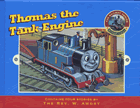
Anyone who was a child once will have read at least one of the Rev. Wilbert Awdry's railway stories about the locomotives with faces who talk to each other. The stories are set at a time between 1945 and the early sixties, between the twilight of steam and the coming of diesel on the railways although some of the later stories are more modern in setting. Awdry created a complete little world on the imaginary island of Sodor which lies between the Isle of Man and Barrow-in-Furness, originally to entertain his son Christopher while he was ill in bed. The rest, as they say, is history.
The Rev. Awdry wrote twenty-seven collections of railway stories, starting with The Three Railway Engines in 1945, and his son Christopher continued the tradition with another nine. The Thomas the Tank Engine phenomenon has proved to be both staggeringly successful and timeless, each new generation discovering the antics of the living locos afresh. With the advent of the animated TV series in the 1980s, set up by Britt Allcroft (who sold her house to buy the rights), they reached an even wider audience and created an international market for merchandising worth millions that shows no sign of diminishing (in America the animated TV series is shown under the title 'Shining Time Station'). Apart from the original railway stories and those written by Christopher Awdry there is a plethora of pop-up books, adaptations, large print picture books, puzzles, toys and even a map of Sodor, all of which help to maintain the profile of the little blue pannier tank engine and his friends. Preserved railways regularly run 'Thomas weekends', and the Mid Hants Railway recently completely rebuilt a saddle tank engine into an almost exact copy of Thomas, and caused an outcry among steam 'purists' by overhauling and putting in steam a tender locomotive to resemble James. In one weekend these two locos turned in a £50,000 profit for the railway, and are regularly lent out due to public demand to meet the characters.
The Background
So what is all this to do with F/SF wargaming? Well, the Railway Stories are fantasies, and with a little imagination can provide a perfect setting for alternative history battles involving armoured trains and the like. With the bulk of the stories set after the Second World War but before Vietnam it is a period usually neglected by gamers so it can make a change from the usual moderns game. The Rev. Awdry created enough background for the railway stories that the Island of Sodor can easily be used as a basis for campaigns or battles. As an example of this, I offer the following outline for a campaign set in an 'alternative' 1958 with an expansionist French Fourth Empire, already dominant in western Europe, attempting to forcibly integrate Britain into the newly-formed European Confederation.
The BBC, August 19th 1958:
Following a continued deterioration in relations between Britain and France as a result of the establishment of a French military presence on the Isle of Man, the Government has issued a final warning to Paris. Unless they are prepared at once to withdraw their troops from the island and their navy from British territorial waters within the next seventy-two hours, steps will be taken to remove them by force. British troops have been placed on alert and the Isle of Sodor's Territorial force has been activated.
The BBC, August 21st 1958:
This morning at dawn French naval units, supported by aircraft flying from bases on the Isle of Man, began landing assault troops of the Foreign Legion on the Island of Sodor. Further landings were made on the Isle of Wight by French Marines, and it is also reported that the Channel Islands have come under air attack. A demand for immediate withdrawal by the British Government has been ignored by Paris, and consequently a state of war now exists between our two countries.
The BBC, August 22nd 1958:
French engineers today destroyed the road and railway bridges linking Sodor with the mainland at Barrow-in-Furness. A French Cruiser and two escorts were sunk by a Royal Navy task force in an engagement in the Sudrian Sea while attempting to land marines at Tidmouth. A Royal Navy destroyer sustained heavy damage during the action. It is reported from sources an the island that staff an the Sodor Railway are refusing to co-operate with French engineers trying to operate the system. The English Channel has been closed to commercial shipping and the Royal Navy has been involved in a number of successful actions against French naval units. Air activity aver the south coast is reported as 'heavy'.
The BBC, August 26th 1958:
Reports are coming in of resistance activity on Sodor Including the destruction of the locomotive works at Crovan's Gate. It has been confirmed that the Foreign Legion have executed Sir Topham Hat, the controller of the island's railway network for refusing to disclose the whereabouts of a number of locomotives. French paratroopers were dropped in battalion strength around Reading yesterday, and were reported as threatening communications with London. Centurions of the Royal Tank Regiment supported by Territorial infantry units are engaging.
The BBC, August 29th 1958:
The harbour station at Knapford on Sodor was destroyed this morning by a locomotive pulling a truck full of blasting explosive. The French have made a formal protest about alleged terrorism by railway workers. It is also reported that a French patrol was fired an by what they described as an armoured train following the attack on Knapford harbour. French air force bombers again attacked the Barrow-in-Furness docks this afternoon causing heavy damage. Three aircraft were shot down. Royal Marines landed an the Isle of Wight during the night and are involved in fierce fighting around Cowes and Ryde. French artillery continues to shell Portsmouth.
The BBC, August 30th 1958:
British aircraft undertook a number of missions across the isles of Sodor and Man today. The main French airbase an the Isle of Man was extensively damaged by a large Canberra raid, and the airstrip on Sodor was put out of action by Fleet Air Arm Sea Venoms and Sea Furies flying from carriers in the Irish Sea. A reconnaissance sweep of Sodor confirmed the existence of at least one armoured train operating against the French, presumably crewed by Sodor Railway staff. For the first time since hostilities began British aircraft bombed the French mainland: Victors, Vulcans and Valiants carried out saturation raids on Cherbourg and Le Havre, closing both ports and causing heavy damage.
The BBC, September 1st 1958:
British heavy bombers again attacked French ports and military installations this morning, disrupting the deployment of EC reinforcements to the Isle of Wight and Southern England. Two Royal Navy destroyers were sunk by enemy submarines In the Sudrian Sea last night whilst carrying out shore bombardment duties. Contact with the remaining troops an Sodor was lost in the early hours of this morning, and it is feared that French Foreign Legion units have carried out their threat to 'exterminate' all opposition to their occupation.
The BBC, September 2nd 1958:
Further proof of resistance activity on Sodor has been received following confirmation from French sources that the last British troops on the island were 'neutralised' after refusing to surrender on September 1st. The main engine sheds at Tidmouth were damaged by an armoured train which pulled into the station and fired a number of captured French anti-tank weapons into the sheds and set then on fire before steaming away. French reports state that their pursuit was prevented by railway workers who deliberately set the points to direct their train into a blind siding. Elsewhere on Sodor a Foreign Legion patrol suffered heavy casualties after being hit by runaway slate trucks at a level crossing...
The Game
But how can I put all this on the tabletop I hear you cry? Where are the figures and locomotives to be found? Panic not, there are sources for both easily accessible to all.
Let's deal with the main ingredient first - Thomas and his friends. There are six really famous engines (not trains, trains are what engines pull). They are:
Thomas the Tank Engine (Billington E2 0-6-0 tank, standard gauge)
Edward the Blue Engine (Rebuilt 'Seagull' 4-4-0 tender, standard gauge)
James the Red Engine (Rebuilt Hughes Class 28 2-6-0 tender, standard gauge)
Gordon the Big Engine (Gresley/Stanier hybrid 4-6-2 tender, standard gauge)
Henry the Green Engine (Stanier Class 5MT 4-6-0 tender, standard gauge)
Percy the Small Engine (Rebuilt Avonside 0-4-0 saddle tank, standard gauge)
They are joined at various times by a number of other engines and mechanical contrivances, including the following:
Toby the Tram Engine (J70 0-6-0 tank, standard gauge)
Skarloey (Fletcher/Jennings 0-4-0 saddle tank, 2' 3" gauge)
Boco (Metropolitan/Vickers Type 2 Co Bo Diesel Electric, standard gauge)
Daisy (Metropolitan-Cammell Diesel Mechanical Railcar, standard gauge)
Duncan (Barclay 0-4-0 welltank, 2' 3" gauge)
Donald & Douglas (McIntosh Class 812 0-6-0 tender, standard gauge)
Duck (Collett Class 57xx 0-6-0 pannier tank, standard gauge)
Duke ('George England' type 0-4-0 tender/saddle tank, 2' 3" gauge)
Peter San (Kerr Stuart 0-4-2 saddle tank, 2' 3" gauge)
Bill and Ben (Bagnall 'Low Slung' 0-4-0 saddletank, standard gauge)
Annie and Clarabel (Thomas' Coaches)
Henrietta (Toby's Coach)
Harold the Helicopter
Trevor the Traction Engine
Bertie the Bus
Terence the Caterpillar Tractor
Most of these engines and other mechanical characters are available as die cast or plastic toys in a variety of scales. For our purposes though, the most useful is the ERTL Thomas the Tank Engine and Friends range of blister packs available pretty well everywhere. They're all to a constant scale and by a massive stroke of luck that scale is 15mm. The range includes all the most important engines together with coaches and rolling stock such as those good old troublesome trucks, not to mention Harold, Terence and Bertie. Prices are from about £3 to £6 depending on which model you buy and where you buy it from (although they're free If you steal then from small children of course).
As the engines etc. are available in 15mm it makes dealing with vehicles and troops relatively easy. The British Army in 1958 looked to all intents and purposes identical to the British Army of 1945 - battledress, '37 or '44 pattern webbing, "turtleback" steel helmets and Lee Enfields, Stens and Brens. Figures and contemporary vehicles such as Centurion tanks are available from a number of manufacturers. Enemies can come from any source and as it's Fantasy, it doesn't matter if they (or the British for that matter) aren't accurate. In fact, it would be nice to have alternative Brits with '58 webbing and the EM2 7mm "bullpup"' assault rifle that Britain was set to adopt in 1951 before the Americans blocked it in favour of the NATO 7.62mm universal round. Still, a paint job and some head-swapping on modern Brits would do the job just as well.
What about rules then, you say? Well, write your own or adapt a Second World War set and stop wasting my tine. In fact, the main problem with rules is how to deal with the railway engines, and that's not too much of a problem. Although the engines are 'alive' they can't operate without a crew so they can be treated as standard locos in terms of operation. They can't go anywhere except on rails, their forward and reverse speeds are the same, and they take longer to stop and start than normal vehicles. The big advantage of trains is the speed they can shift troops and supplies and the amount they can carry, the big disadvantage is they can only go where the rails are which can make then vulnerable and inflexible. It's also important to remember that some of the lines on Sodor are Narrow Gauge so the engines will be smaller and less useful than the big Standard Gauge jobs like Thomas and James. With that information in mind simple rules to tie in with whatever set you're using for combat aren't too difficult. Just remember to be a bit creative here and there - the engines can think for themselves and should be capable of the odd surprise (remember how Henry sneezed over the bays on the bridge, or how Percy slipped his brakes and crashed into the station master's house?) How about morale rules for the engines in order to restrict their uses and abilities?
Anyone who wants to find out more about the background to the railway stories and the Island of Sodor should have a look at the following sources: Rev W Awdry and G Awdry, The Island of Sodor, Its people, history and railways, Kaye and Ward, 1986. A fascinating glimpse into how the phenomenon was created and the way the background expanded as the stories were written, leading to a fully developed alternative reality.
Wall map of the Island of Sodor, William Heinemann Ltd, 1992. Superb full colour relief map of the Island showing railways, towns and capital city, its position relative to the mainland and references to all the places mentioned in the books.
The twenty-seven books written by the Rev W Awdry himself, in particular the first ten or twelve. The first dozen introduce all the really important and famous engines and cover the stories most people know like 'The Flying Kipper' and the classic 'Troublesome Trucks'.
With grateful thanks to my brother Richard, whose knowledge and library of the Railway Stories and related matter is encyclopaedic, and without whose help I could not have written this article. He'll probably never speak to me again ...