
World War Two Books
Berlin: the Downfall, 1945 by Antony BeevorMilitary history, even at its best, can be a cold art. It's easy to lose sight of the fact that wars involve individuals, each with their own hopes, fears and desires. Berlin: the Downfall, 1945, is Antony Beevor's account of the bloody Götterdämmerung that brought the Second World War in Europe to an end, and in which he has fused the large and the small scale effects of war. Beevor paints the broad picture of Marshals Zhukov and Konev, competing for glory and Stalin's attention, as they race their armies towards Berlin. He gives the reader a gripping account of the brutal street-by-street fighting in the German capital and provides an unforgettable portrait of the last, insane days of Hitler and his entourage in the bunker. His attention to emotional detail is what made his previous book Stalingrad such a magnificent work, combining a sweeping hisorical narrative with a remarkable sensitivity to human drama. Yet he also highlights the small details of ordinary people caught in the nightmare of history--the sick children evacuated at the last minute from a Potsdam hospital; the Soviet soldiers shaving themselves for the first time in weeks so that they would make appropriately presentable conquerors; and the Nazi Youth teenagers peddling their bikes in despairing, last-ditch attacks against the Red Army's tanks. The story Beevor tells is an almost unremittingly terrible one--one of death, rape, hunger and human misery--but he tells it with both an epic sweep and an alertness to individuality. The result is a masterpiece of narrative history that is as powerful as Stalingrad. |
||
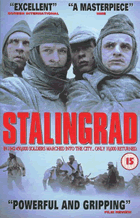
Stalingrad by Antony BeevorHitler made two fundamental and crippling mistakes during the Second World War. The first was his whimsical belief that the United Kingdom would eventually become his ally, which delayed his decision to launch a major invasion of Britain, whose army was unprepared for the force of blitzkrieg warfare. The second was the ill-conceived Operation Barbarossa--an invasion of Russia that was supposed to take the German army to the gates of Moscow. Antony Beevor's thoughtfully researched compendium recalls this epic struggle for Stalingrad. No one, least of all the Germans, could foretell the deep well of Soviet resolve that would become the foundation of the Red Army; Russia, the Germans believed, would fall as swiftly as France and Poland. The ill-prepared Nazi forces were trapped in a bloody war of attrition against the Russian behemoth, which held them in the pit of Stalingrad for nearly two years. Beevor points out that the Russians were by no means ready for the war either, making their stand even more remarkable; Soviet intelligence spent as much time spying on its own forces--in fear of desertion, treachery and incompetence--as they did on the Nazis. Due attention is also given to the points of view of the soldiers and generals of both forces, from the sickening battles to life in the gulags. Many believe Stalingrad to be the turning point of the war. The Nazi war machine proved to be fallible as it spread itself too thin for a cause that was born more from arrogance than practicality. The Germans never recovered, and its weakened defences were no match for the Allied invasion of 1944. We know little of what took place in Stalingrad or its overall significance, leading Beevor to humbly admit that "[t]he Battle of Stalingrad remains such an ideologically charged and symbolically important subject that the last word will not be heard for many years". This is true. But this gripping account should become the standard work against which all others should measure themselves. |
||
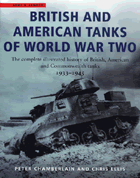
British and American Tanks of World War TwoThis complete illustrated history of British, American and Commonwealth tanks, gun motor carriages and special-purpose vehicles between 1939 and 1945 provides a detailed history of each type, plus full pictorial coverage of the many variants which were produced on each chassis. |
||
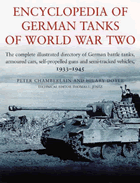
Encyclopedia of German Tanks of World War TwoA guide to the tanks and other armoured fighting vehicles of the Third Reich. The result of research, it was first published in 1978, and has been revised and updated since to provide more information. Here are the complete technical and combat histories of all German World War II AFVs, in standard data layouts and arranged in sections by type. It contains over 1000 photographs, a glossary of German technical terms and English translations, eight appendices covering armament, ammunition, engines and other equipment. Contents include: Panzerkampfwagen I and II; Panzerkampfwagen 35(t) and 38(t); Panzerkampfwagen III; Panzerkampfwagen IV; Panzerkampfwagen V (Panther); Panzerkampfwagen VI (Tiger); plus variants on all Marks; miscellaneous fully-tracked vehicles; semi-tracked vehicles; armoured cars; and French, Italian and captured enemy vehicles in German service. Order it now from amazon.co.uk.
|
||
|